Tuesday, October 2, 2012

From Iraq to Iran


"He [Saddam] now has this distributed in little sites, tiny sites, tiny centrifuges the size of washing machines, and they're hidden. Are you going to find them? Iraq is a very big country. He's got 50 palaces with secret trap doors. I mean it's not going to work. It doesn't work that way. It didn't work up to now, it's not going to work." Benjamin Netanyahu

Probably Mr. Netanyahu ist still believing Saddam's WMD are there in Iraq, somewhere hidden under the hot desert sand, invisible for satellite surveillance, too tiny to be found. Yes, nobody can find them behind the secret trap doors (is '50' taken from the Thora?), they are just too tiny, pinpoint almost ... And this is probably also the reason for not finding WMD in Iraq down to the present day, they just too tiny, hidden in tiny places ...
... what a nonsense, but obviously good enough for the US-American audience; kind of oriental scary story coming from a man who knows how easily the US can be drawn into a war (see America is easy to push around or 'America Is A Thing You Can Move Very Easily'). On another occasion the minstrel sang his song with such overemphasized 'feverishly' that it sounds almost funny in our ears listening backwards through time during which no trace of WMD in Iraq other than those of the invaders have been found.

"It is simply not reflecting the reality to assume that Saddam is not feverishly working to develop nuclear weapons, as we speak.” Benjamin Netanyahu, Benjamin Netanyahu speaking to House Committee on Oversight and Government Reform.


And the man goes on and on. But in contrast to Richard "Dick" Cheney - who put forward his 1% Percent-Rule for attacking other countries or Colin Powell, whose infamous performance in front of the UN General Asembly has become a classic of war propaganda, dubious Mr. Netanyhu doesn't dwell for long with arguing or presenting evidence, he just tries to convince people that other nations in the Middle-East than Israel cannot be given the bomb. Thus, just as he was agitating against Iraq "we cannot allow a world in which Saddam acquires nuclear weapons", he is fear- and warmongering against Iran by evoking ad nauseam the angst of freakish Muslim leaders:  "just imagine Iranian aggression with nuclear weapons. Imagine their long range missiles tipped with nuclear warheads, their terror networks armed with atomic bombs." In fact, he only takes Cheney's 1% and multiplies it with some value big enough to blow it up to an allegedly real threat. We can call it the Netanyahoo-Factor (in other words, the amount of Chutzpah needed to make up a 1% chance of a catastrophic event to look like an absolute necessity).


How dubious is this guy? Once Israeli Newspaper Haaretz wrote about a video showing Netanjahu bragging about how he's dealing with the Oslo peace process and the "ally" USA:


"This video should have been banned for broadcast to minors. This video should have been shown in every home in Israel, then sent to Washington and Ramallah. Banned for viewing by children so as not to corrupt them, and distributed around the country and the world so that everyone will know who leads the government of Israel."


Alternatively, watch video and transcript here: ‘The world won’t say a thing’– Netanyahu on ongoing Israeli expansion"

"Netanyahu: Especially today, with America. I know what America is. America is something that can easily be moved. Moved to the right correction.
Child: They say they’re for us, but, it’s like…
Netanyahu: They won’t get in our way. They won’t get in our way."


Further reading: an article from 1996: "Spook, Terrorist or Criminal? America’s Mysterious Files on Netanyahu"

Saturday, September 29, 2012

Why Wait for a Military Incident?


Patrick Clawson - a warmonger with a long catalogue of sins (see the entry in the Right Web) - explains "the traditional way that America gets into war" as follows.

"I frankly find that crisis initiation is really tough. And it’s very hard for me to see how the United States President can get us into war with Iran. Which leads me to conclude that if in fact compromise is not coming that the traditional way that America gets into war is what would be best for U.S. interests.
Some people might think that Mr. Roosevelt wanted to get us into World War II, as David mentioned, you may recall we had to wait for Pearl Harbor. Some people think Mr. Wilson wanted to get us into World War I, you may recall we had to wait for the Lusitania episode. Some people might think that Mr. Johnson wanted to send troops to Vietnam, you may recall we had to wait for the Gulf of Tonkin episode. We didn’t go to war with Spain until the USS Maine exploded. And may I point out that Mr. Lincoln did not feel he could call out the Federal Army until Fort Sumter was attacked which is why he ordered the commander of Fort Sumter to do exactly that thing which the South Carolineans had said would cause an attack.
So if in fact the Iranians aren’t going to compromise, it would be best if somebody else started the war. One can combine other means of pressure with sanctions. I mentioned that explosion on August 17th. We could step up the pressure.
I mean look people, Iranian submarines periodically go down, some day one of them might not come up, who would know why? We could do a variety of things if we wish to to increase the pressure. I’m not advocating that, but I’m just suggesting that this is not an either or proposition, you know it’s just sanctions have to succeed or it’s other things.
We are in the games of using covert means against the Iranians. We could get nastier."

You're nasty enough, terrorizing the world.

There is a little historical distortion in what Clawson said. There is no real (or false-flag) military incident necessary. In fact, the US take ANY opportunity to start a war or send their troops, if it serves their interests (political and financial hegemony). Empires and hegemonic powers have always been opportunists, trying to take advantage of EVERY situation that comes along, and so does the US:

- There is an earth-quake? Let's go to Haiti!
- There are two airliners crashing into two sky scrapers and three buildings are coming down (like in a controlled demolition)? Let's go to Afghanistan!
- There is a heart-breaking story of Kuwaiti babies taken out of their incubators and left to die by Iraqi soldiers? Let's go to Iraq! (see Nayirah, a classic of war propaganda)
- Mhm, there is nothing? Let's apply the Cheney Doctrine and go again to Iraq!


See the video of Clawson's speech


Thursday, September 27, 2012

Die Sehnsucht nach Krieg


27-09-2012: Heute wird der derzeit amtierende Weltmeister in Kriegspropaganda, der Israelische Ministerpräsident Netanjahu, vor der UNO-Vollversammlung sprechen. Anlässlich dieses Ereignisses schreibt eine Frau Juliane von Mittelstaedt im Spiegel Online:


"Eilig geführte Umfragen ergaben angeblich, dass eine Mehrheit der Israelis diesen Krieg fast schon herbeisehnt, egal um welchen Preis. Nur lässt der Schlag gegen Irans Nuklearanlagen auf sich warten." (Der Krachmacher - Netanjahus Iran-Rede vor der Uno)

Diese Zeilen erinnern so stark an den heißen Sommer des Jahres 1939 und die Kriegserwartungen der Polen und Deutschen, daß einem schlecht werden könnte (vergleiche "Nervenkrieg" - Weichgekocht durch Propaganda).


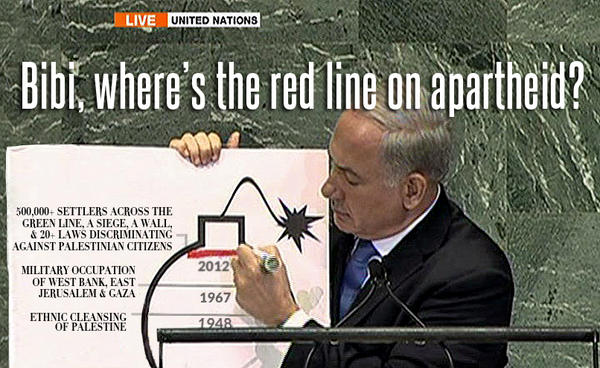
update 28-09-2012: Netanjahus Rede stellte sich wieder einmal als Abfolge mythologischer Geschichten und Spekulationen heraus. Sie begann mit "vor 3000 Jahren herrschte König David über den jüdischen Staat (sic!) in unserer unteilbaren Hauptstadt Jerusalem". (Hier das english transcript). Ich erspare mir hier den Rest, außer dieser Sache mit der Schautafel, die er verwendete, um seinen Zuhörern zu erklären wie eine Bombe funktioniert, oder so ... (Österreicher werden sich an Jörg Haider erinnert fühlen, der 1994 als Erster bei einer Wahldiskussionsrunde im Fernsehen sein berühmtes "Schautaferl" auspackte.*)
Jedenfalls gibt es in der Blogosphäre seither eine neue Welle von Satiren über die "Bibi-Bomb" (ein Ausdruck der geprägt wurde, als sich der israelische Premier bei der Rückkehr Gilad Shalits vor Journalisten ein bißchen zu sehr in den Vordergrund rücken wollte).


Bibi explains the Bullshit Meter: http://joequinn.net/author/joe/


Bibi explains why bags of potato chips consist mostly of air.
  http://israelity.com/2012/09/28/bibi-and-the-bomb/ 


*
aus Thomas Höfer: "Spin Doktoren in Österreich: Die Praxis amerikanischer Wahlkampfberater. Was sie können, wen sie beraten, wie sie arbeiten."


Thursday, September 20, 2012

Randnotiz zum Anti-Islam Video


Nachdem angeblich koptische Christen mit Hilfe eines ulkigen Schüler-Videos vorgeblich die halbe moslemische Welt dazu gebracht hatten wie auf Knopfdruck auf die Barrikaden zu steigen, könnte man sich wieder einmal die Frage stellen, was die Christenheit tatsächlich über "die anderen" denkt. Schlagen wir mal im Wörterbuch nach:


Koran subst. masc.
Ein Buch, von dem die Moslems törichterweise glauben, dass es auf göttliche Inspiration zurückgehe, von dem jedoch die Christen wissen, dass es sich um eine bösartige Hochstapelei handelt, die im Widerspruch zur Heiligen Schrift steht.
 Ambrose Bierce, Aus dem Wörterbuch des Teufels


Falls Sie ein Christ sind und diesen Witz nicht verstanden haben sollten, dann wird Ihnen der Eintrag über die "Heilige Schrift" auch nicht weiterhelfen:


Bibel subst. fem.
Das heilige Buch unserer Religion, im Unterschied zu den falschen und profanen Schriften, auf denen alle anderen Glaubenslehren beruhen.
Ambrose Bierce, Aus dem Wörterbuch des Teufels

Ok, machen Sie sich nichts vor! Sie haben einfach nicht kapiert, um was es geht ...


Heilig adj.
Einem religiösen Zweck geweiht; göttlicher Natur; feierliche Gedanken und Gefühle einflößend wie: der Dalai Lama von Tibet; der Mugum von M'bwango; der Affentempel in Ceylon; die Kuh in Indien; das Krokodil, die Katze und die Zwiebel im alten Ägypten; der Mufti von Muhsch; das Haar des Hundes, der Noah biss, usw ...
Ambrose Bierce, Aus dem Wörterbuch des Teufels


Tuesday, September 18, 2012

Derivatehändler: "Etwas weniger Krieg und etwas weniger Korruption"


Die USA haben heuer rund 1 Bio. $ mehr ausgegeben als durch Steuern eingenommen. Gemessen am Bruttoinlandprodukt (BIP) hat nur Griechenland ein noch höheres Defizit. Im Gegensatz zu den Südeuropäern haben die Amerikaner jedoch ihr Schicksal in der eigenen Hand. Sie können mit Sparmassnahmen den Haushalt schnell wieder in Ordnung bringen, zumal die grössten Ausgaben einerseits beim Militär und anderseits in der Krankenpflege liegen. Etwas weniger Krieg und etwas weniger Korruption bei Ärzten und Spitälern – und die USA wären wieder auf Kurs. An Wachstumskraft und Wettbewerbsfähigkeit fehlt es nicht. Dazu kommt, dass die Abwertung des Dollars und die rekordtiefen Erdgaspreise zur Senkung der Produktionskosten im internationalen Vergleich beigetragen haben. Selbst Apple-CEO Tim Cook hat schon laut darüber nachgedacht, einen Teil seiner Produktion wieder in die USA zurückzubringen. (Der US-Schuldenberg als Krebsgeschwür, Krim Delko, NZZ Online, 18.9.2012)

Im Prinzip stellt der parasitäre Bereich des US-Militärs mit allen seinen privaten und staatlichen Handlangern ebenso eine Art von Korruption dar, wie das US-Gesundheitswesen, das von Pharmariesen dominiert wird. Letztlich sind jene aber doch nur zwei von vielen Stolpersteinen, die dem Hegemon zum Verhängnis werden müssen. Da es sich beim Schreiber der eingangs zitierten Zeilen um Krim Delko handelt - einem Derivatehändler, muss man sich auch nicht fragen, warum er das US-Bankwesen ganz unerwähnt lässt. In der Krise schieben sich die Verantwortlichen gegenseitig die Schuld zu. Man merkt, dass wir uns nun schön langsam wieder weg von der Eurokrise hin zum US-Schuldenberg bewegen dürfen, denn das sog. Fiscal Cliff der USA muss bis Jahresende 2012 abgehandelt werden.

Siehe auch:  »Fiscal Cliff« — nicht das einzige Problem der US-Haushaltspolitik
U.S. health care is a 'subtle form of corruption' says leading cancer doctor
Eisenhower and the Merchants of Death
Guns-to-Caviar Index / Kaviar-Kanonen-Index


Sunday, September 9, 2012

Guess Which City, Which Country?


Click on pictures to enlarge:

city center around a channel I
city center around a channel II

fountain, city center
natural river near city center


various crowded squares 

a restaurant
they nicknamed it "Marcus Square"
view from the arcades of "Marcus Square"

office buildings
long boulevard across the City
bus stop somewehre outskirts of town


Any idea which city? At least which country? Scroll down to see solution:
>
>
>
>
>
>
>
>
>
>
>
>
>
>
>
>
>
>
>
>
>
>
>
>
>
>
>
>
>
>
>
>
>
>
>
>
>
>
>
>
>
>
>
>
>
>
>
>
>
>

The city's name is Yóshkar-Óla (Йошкар-Óла), capital of the Republic Mári-El (Республика Марий Эл), Russian Federation, around 800 km east of Moscow. Surprised?

The indigenous population of this republic is called the Mari People (марийцы), currently about 44% of the total population, not much less than ethnic Russians (49%). Besides Russian, the uralic or finno-ugric Mari language is an official language of the Republic (e.g. road and traffic signs as well as captions on official buildings are in both languages). Mari is also taught in schools. Though pressed by monotheistic religions in neighboring republics, Mari natural religion is still practiced today (see also Mari Traditional Religion).* 

The busy building activities in and around Yóshkar-Óla are due to Governor Leonid Markelov, who is said to have a passion for Brugge, Belgium. Probably without asking the people, he decided that the capital ought to be a Brugge lookalike (compare following 2 pics).

Brugge's famous market square
(Grote Markt)
Brugge: Grote Markt during
 upcoming storm


And even if the non-Russian features of the new appearance of the city sometimes border on the ridiculous (in the center there is a statue of Rainier III, Prince of Monaco together with his Grace Kelly), citizens overwhelmingly seem to appreciate what is done for their hometown, even though practically everybody seems to believe one of the construction firms in charge is owned by Irina Konstantinova Markelova, the Governor's wife. Moreover, some people say the Governor's family residence - a palace - is situated right in the middle of the city - close to the biggest orthodox church building, surrounded by the same walls and protected by the same security (I have no evidence for the statement concerning the family, so it might be only a rumor ;-)

The center is designed completely new (but with some churches built on historic ground). There is a broad boulevard through the whole city where people use to go walking, especially in the evening - really a very nice meeting point with flowers and fountains; parks are well cared for. During the last decade a series of sports facilities has been built: two ice rinks, two indoor swimming baths (one for children only),

Indoor Tennis Center
Children's Indoor Swimming Bath

one indoor tennis center, a new football stadium (though Yóshkar-Óla is only a bad third league club) and other outdoor Astroturfs, a roofed athletics stadium is being under construction. Btw, even the football stadium looks very similar to Brugge's "Jan Breydel Stadion"(!)
Ticket prices for these facilities are modest: from 18:00 to 22:00 working people may enter the indoor bath for 3 euros; the indoor tennis court though is 12 euros per hour. Recently, the city is flooded by more and more restaurants. Newly arrived MacDonald's has a hard stand in fighting the competitors arising from various domestic Russian restaurant chains; also, the number of upscale restaurants is on the rise (surprisingly, there is a wheat beer brewery owned and run by a German).

Yóshkar-Óla kindergarden I

Yóshkar-Óla kindergarden II

In addition, street cafés, museums (the Mari Museum is very recommendable), theaters, operas and unfortunately a huge number of newly built churches, ... , new Yóshkar-Óla has much more to offer than one would expect from a Russian provincial small town (inhabitants about 270 000). Formerly a typical grey Soviet city with its faceless structure, poor apartment blocks and depressing housing situation, the ongoing construction boom is striking. (If there wouldn't be still a strong demand in Russia for new living space, one could think there is a real estate bubble like in Spain or the USA not long ago). If you fly to Moscow over its surrounding area, you can see lots of swathes cut into the woods, inside with town houses and gated communities of the rising Muscovite's middle class and - of course - the palaces and mansions of the "nouveau riches" and the oligarchs. This cannot yet be seen in Yóshkar-Óla. But even there new private homes are built and are starting to change the face and the atmosphere of the city.

new middle-class home near
Malaya Kokshaga river II
new middle-class home near
Malaya Kokshaga river I

If you ask the citizens of Yóshkar-Óla how they would explain this rapid development of their city, you get mainly two different answers. The majority tends to believe that "this is just the beginning of a Russia-wide positive economic and political development". The alternative answer says "it's just another Potemkin".

Anyway, the whole region has much potential. Yóshkar-Óla is only a few miles away from the beautiful sandy river banks of the Wolga and directly connected with it via natural rivers. The city is surrounded by woods with lakes and rolling hills, perfect for mushrooms! You don't need to be a prophet to predict that the region will attract more and more tourists in the near future, domestic and international.


Some more Impressions from Yóshkar-Óla, Republic of Mari-El, Russia.


market hall
inside market hall, private vendors
 offering meat 


wedding


golden stretch limo

old soviet style theater
medieval music on the boulevard

small church on main square
relaxing in the evening
boats on the Malaya Kokshaga river,
 after sunset
fireworks in Yóshkar-Óla
colorful buildings in contrast
to old soviet architecture

a Russian bank


*In comparison, neighboring Chuvash Republic has more than 2 thirds of indigenous Chuvash people (descendants of the ancient kingdom of the semi-nomadic Bulgars until  the 13th century), the bilingual conditions are similar and the Chuvash natural religion is still active (Vattisen Yaly). In contrast, Tatarstan has around 55% Muslims and 45% Russian Orthodox (according to Wikipedia) - not much of natural religion left. 53% of the population are Tatars, 39% ethnic Russians.

Thursday, August 2, 2012

Oh, How We Love Our Oriental Rulers!


Now, the West loves brutal dictators - as long as they keep their cruelties secret and as long they play by the rules - OUR rules, or - to be more precise - the rules of big business. We loved when crazy Gaddafi  resided in a tent on Donald Trump's property in New York and was eager to supply oil, we loved when the Trabelsi Clan provided us with cheap labor slaves and hotels to serve us Western tourists on Tunesia's golden beaches; we loved the outsourcing, the money laundering and the weapon deals with the Mubarak Clan in Egypt, we loved Yemen's Saleh and offered him refuge just as we liked the Shah of Persia and Saddam, and we still love the Gulf states - especially Saudi Arabia - because we can make such a good business with them and they really manage to keep their fellow citizens down and torture in the dark. And we all know: Syria is next. Assad was good, but he couldn't keep his people effectively under control. So don't wonder why "Obama authorized covert support for Syrian rebels"! This is just the "Syrian war of lies and hypocrisy" as one of the last remaining journalists said. Don't you worry, we'll find another dictator for Syria and then we apply democracy there!